


Understanding Polygraph Retesting: What Research Reveals About Multiple Examinations

The Core Question — Explained the Way I See It
One thing I get asked all the time is this:
“If someone fails a polygraph, what happens if they take it again? Does the accuracy get better, worse, or stay the same? And do innocent people eventually get cleared while deceptive people get caught?”
A classic 1986 study by Douglas Grimsley and William Yankee gives us some solid answers. And honestly, what they found lines up with what I’ve seen in the field for years.
How the Study Worked
Eighty college students were tested over three days. They were split into two groups:
Truthful subjects (50 people) — they didn’t lie or commit any deceptive act
Deceptive subjects (30 people) — they did mock crimes, lied on applications, or hid mental‑health consultations
And here’s the interesting part: Everyone was told they failed every test, even the ones who actually passed. That pressure let researchers see what happens when people are retested under stress.
What They Found

Accuracy Stayed Consistent
Across all three tests, examiners stayed in the 73–78% accuracy range (not counting inconclusive results).So no, accuracy doesn’t fall apart with retesting.
Truth Helps the Innocent
The biggest takeaway: examiners were more accurate with truthful people than deceptive ones.
Truthful subjects: 81–83% accuracy
Deceptive subjects: 63–72% accuracy
That gap matters — and it’s one reason polygraph is such a powerful screening tool.
Retesting Protects Innocent People
This is where the study really shines.
After Test 1
35 of 50 innocent people passed
15 were false positives
After Test 2
Of those 15 who initially failed:
8 were correctly cleared
Accuracy jumped to 86%
After Test 3
Of the remaining 7:
2 more were cleared
Final accuracy: 90%
With inconclusives removed: 96%
Bottom line: Retesting dramatically reduces false positives. Innocent people rise to the top the more you test.
Retesting Also Catches the Guilty
After Test 1
8 guilty subjects passed (false negatives)
After Tests 2 and 3
Only 3 of those 8 kept passing
Final detection rate: 90%
So the more you test, the harder it is for deceptive people to keep slipping through.
Why This Matters — The “Successive Hurdles” Approach
This study supports what many agencies already do: If someone fails, you retest.
And here’s why:
It protects innocent people — false positives drop dramatically
It exposes deception — guilty subjects struggle to maintain the lie
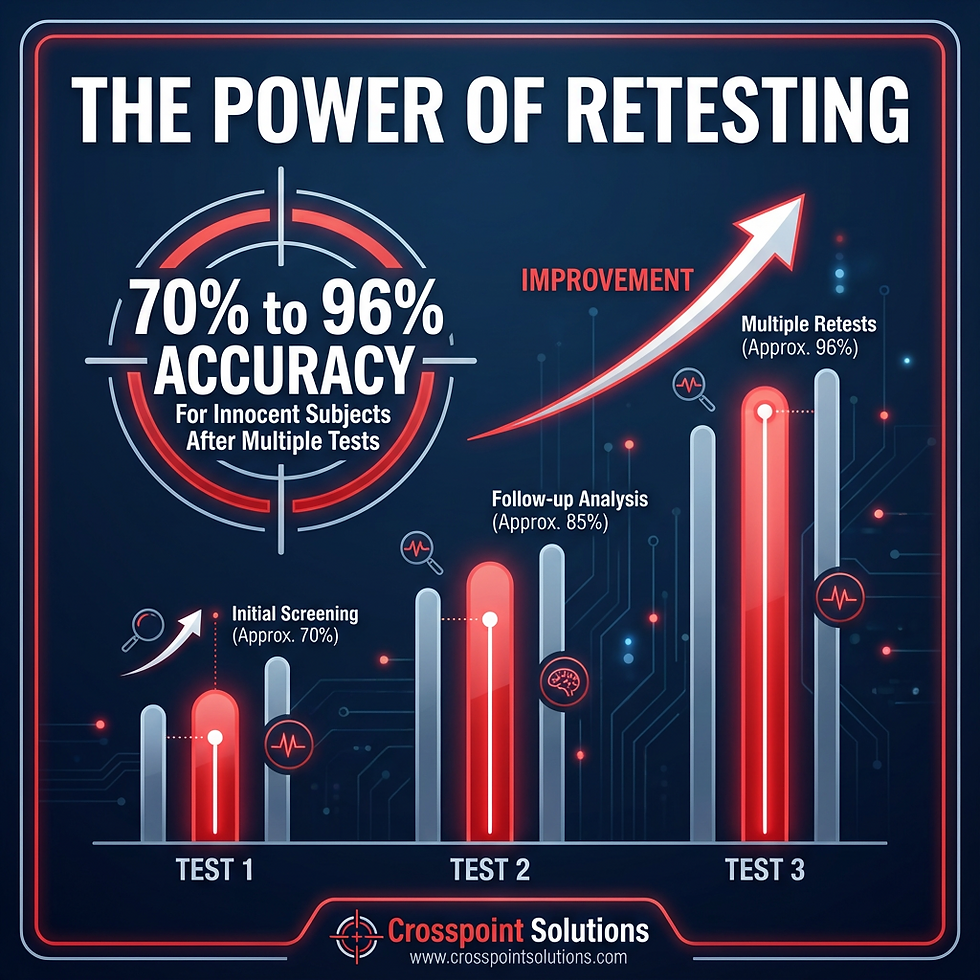
It boosts overall accuracy — from 70% on the first test to 90–96% with retesting
This is exactly why a single test should never be treated as the final word.
Other Interesting Notes
Women scored slightly higher accuracy rates than men
GSR (skin response) was the strongest single indicator
CAM (cardio activity monitor) performed surprisingly well
Breathing patterns were the least reliable, especially on the second test
These findings still influence how we structure exams today.
Practical Takeaways for Agencies
If you’re using polygraph for screening or monitoring, this research makes one thing clear:
A first‑time failure doesn’t automatically mean deception
Innocent people benefit from retesting
Truly deceptive individuals rarely survive multiple rounds
This is why retesting isn’t just fair — it’s scientifically supported.
The Human Side of It
Even when innocent subjects were told they failed, they stayed consistent and often passed later tests. Guilty subjects, on the other hand, struggled more and more each time.
That’s exactly what we see in real‑world cases.
Limitations (Worth Mentioning)
This was a lab study:
College students, not real applicants
Low stakes ($45 max payout)
Mock scenarios, not real crimes
But even with those limitations, the results line up with decades of field experience.
The Bottom Line
Multiple polygraph tests make the system more accurate, especially for innocent people.
One test isn’t the whole story
Truth becomes clearer with each retest
Deception gets harder to maintain
This is why retesting is part of best practices across the industry.
At Crosspoint Solutions LLC
This research reflects exactly how we operate:
We know an initial failure doesn’t automatically mean deception
We offer retests when appropriate
We use multiple physiological channels for a complete picture
We hold ourselves to the highest standards of fairness and accuracy
When the truth matters — the science matters.
If you need a professional, research‑backed polygraph examination, Crosspoint Solutions LLC is here to help.
_
Research Reference: Grimsley, D.L. & Yankee, W.J. (1986). "The Effect of Multiple Retests on Examiner Decisions in Applicant Screening Polygraph Examinations" - Published in Polygraph & Forensic Credibility Assessment, 2025, 54(2)


Comments