


The Crucial Role of Rapport in Successful Investigative Interviewing

Updated: Jun 2
Building Trust and Connection During Investigative Interviews: The Key to Uncovering the Truth
================================================================================================
Building trust and connection during investigative interviews is not just a skill—it is the foundation for uncovering the truth. At Cross Point Solutions LLC, years of investigative experience have shown that interviews grounded in rapport consistently yield better results. Research by Abbe and Brandon confirms what seasoned investigators have long understood: rapport-based interviewing leads to more cooperation, richer information, and faster resolutions.

Why Rapport Matters More Than Compliance

Many investigators focus on extracting information through pressure or compliance tactics. Yet, former FBI Agent Ali Soufan highlights a critical difference: he sought actionable intelligence, not mere compliance. When interviewees feel pressured, they often provide what they think the interviewer wants to hear, not the full truth. Rapport creates a space where interviewees feel safe to share accurate and detailed information.
Rapport encourages:
Trust between interviewer and interviewee
Open communication without fear of judgment
Greater cooperation throughout the interview
More detailed and truthful responses
This approach does not weaken investigative integrity. Instead, it strengthens it by producing reliable intelligence that can be acted upon confidently.
The Research Behind Rapport-Based Interviewing
Studies consistently show that rapport-building techniques improve interview outcomes. Investigators who establish rapport early in the process receive more information and experience less resistance. For example, research indicates:
Witnesses share up to 40% more information when rapport is established
Interviews conclude faster when cooperation is high
Trust reduces the need for repeated questioning or confrontational tactics
Despite this evidence, many investigators still neglect rapport. Surveys reveal that a majority of fraud investigators fail to build rapport early, and some never establish it at all. This gap leads to missed opportunities and weaker investigations.
Practical Steps to Build Rapport in Interviews
Building rapport is a skill that can be learned and refined. Here are practical techniques investigators can use:
Start with small talk to ease tension and create a relaxed atmosphere
Use active listening by nodding and summarizing what the interviewee says
Maintain open body language to show attentiveness and respect
Avoid interrupting or rushing responses
Show empathy without compromising objectivity
Ask open-ended questions that encourage detailed answers
These steps help interviewees feel valued and understood, which encourages honesty and cooperation.
Overcoming Challenges in Rapport Building
Some investigators worry that building rapport may be seen as being too soft or manipulative. This is a misconception. Rapport is about genuine connection, not manipulation. It requires patience and authenticity.
Challenges include:
Time pressure to get quick results
Preconceived notions about suspects or witnesses
High-stress environments that encourage aggressive tactics
Addressing these challenges means prioritizing rapport as an essential part of the process, not an optional extra. Training and practice can help investigators balance firmness with empathy.
The Cost of Ignoring Rapport
Failing to build rapport can lead to incomplete or false information, prolong investigations, and increase frustration for all parties involved. It can also damage the reputation of investigative teams and reduce public trust.
At Cross Point Solutions LLC, we emphasize closing the gap between knowing the importance of rapport and actually applying it. The benefits of rapport-based interviewing are clear: better information, faster resolutions, and stronger cases.
The Importance of Professional Polygraph Services
In addition to rapport-based interviewing, Cross Point Solutions LLC offers professional polygraph services that enhance truth verification. Polygraph testing is a scientifically validated method used to assess physiological responses associated with deception. This service is crucial for various applications, including legal investigations, employment screenings, and personal matters.
Understanding Polygraph Testing
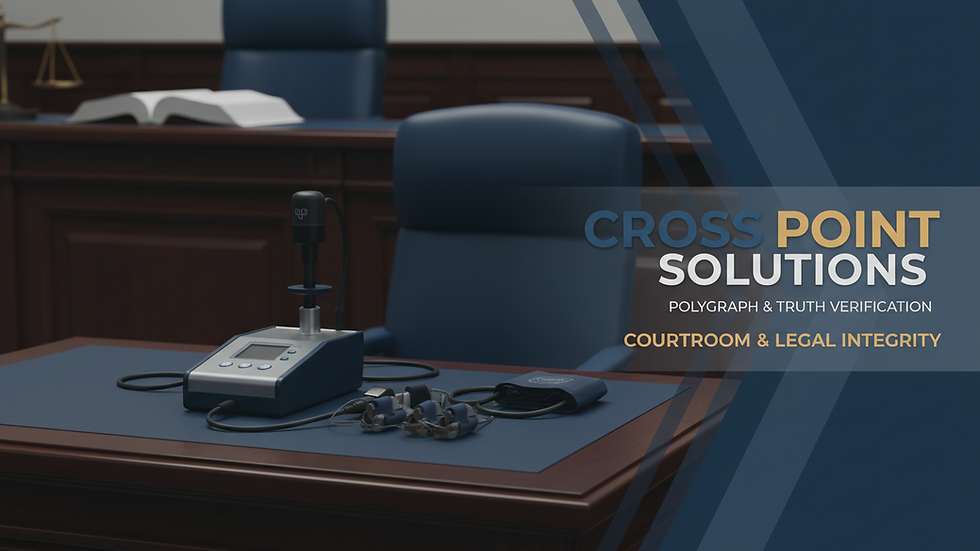
Polygraph testing measures physiological responses such as heart rate, blood pressure, and respiration. These measurements help determine whether an individual is being truthful or deceptive. The process involves a trained examiner who asks relevant questions while monitoring these physiological indicators.
EyeDetect Technology
Another innovative service offered by Cross Point Solutions LLC is EyeDetect. This technology uses eye movement and pupil dilation to detect deception. It is a non-invasive method that can be particularly useful in settings where traditional polygraph testing may not be feasible.
VAST: Verbal Analysis and Stress Testing
Cross Point Solutions LLC also utilizes Verbal Analysis and Stress Testing (VAST) as part of its suite of truth-verification services. VAST focuses on analyzing verbal and non-verbal cues during interviews. This method complements polygraph and EyeDetect testing by providing additional insights into the interviewee's truthfulness.
Final Thoughts
Rapport is the key to unlocking truthful, detailed, and actionable information during investigative interviews. It transforms the interview from a confrontation into a conversation built on trust. Investigators who master rapport-based techniques will find their work more effective and their results more reliable.
For those involved in investigations, the next step is clear: invest time in learning and practicing rapport-building skills. The truth is more accessible when people feel heard and respected. By combining rapport-building techniques with advanced truth-verification services like polygraph testing, EyeDetect, and VAST, Cross Point Solutions LLC stands ready to support professionals in their quest for clarity and confidence during critical moments.


Comments