


Exploring Key Topics in Polygraph Blog Insights

Polygraph technology and truth verification services have become essential tools across various professional fields. From legal teams to mental health providers, and from employers conducting background checks to law enforcement agencies, understanding the nuances of polygraph and related technologies is critical. This article explores key topics in polygraph blog insights, focusing on the differences between polygraph, EyeDetect, and VAST services offered in Colorado Springs by Cross Point Solutions LLC. The goal is to provide clear, credible, and detailed information to help professionals make informed decisions about truth verification.
Understanding Polygraph Blog Insights: The Foundation of Truth Verification
Polygraph testing, often referred to as a lie detector test, measures physiological responses such as heart rate, blood pressure, respiration, and skin conductivity to assess truthfulness. Polygraph blog insights often delve into the science behind these measurements, the testing process, and the legal and ethical considerations involved.
Cross Point Solutions LLC is recognized for its expertise in polygraph services, especially in Colorado Springs, where legal professionals and agencies rely on accurate truth verification. Polygraph testing is widely used in criminal defense, family law, and civil litigation to provide objective data that can support or challenge testimony.
Key points about polygraph testing include:
Pre-test interview: Establishes rapport and explains the procedure.
Question formulation: Critical for accurate results; questions are designed to be clear and relevant.
Physiological monitoring: Sensors record responses during the test.
Analysis and reporting: Expert examiners interpret data to determine truthfulness.
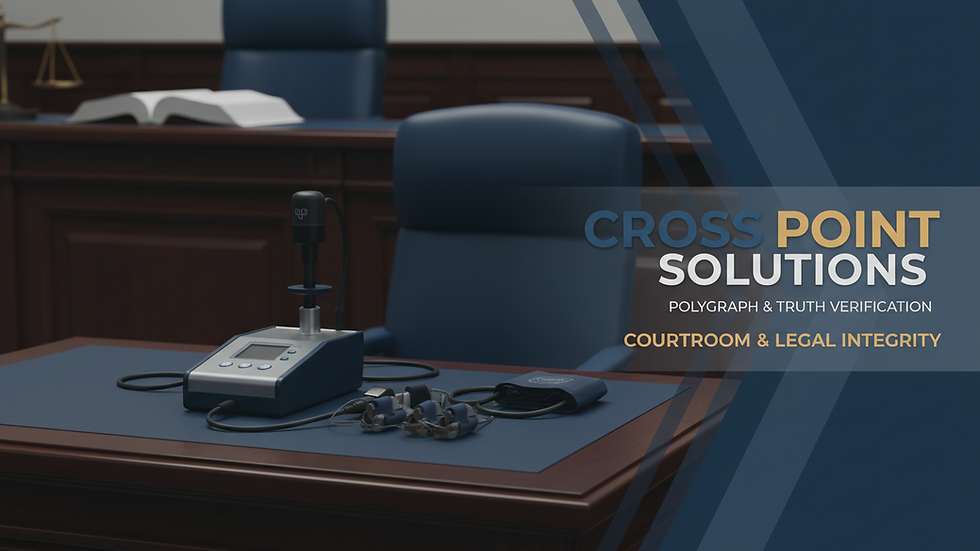
Polygraph blog insights also emphasize the importance of examiner qualifications and adherence to professional standards. This ensures that results are reliable and legally defensible.
Comparing Polygraph, EyeDetect, and VAST Services in Colorado Springs
Cross Point Solutions LLC offers a range of truth verification services, including traditional polygraph testing, Converus EyeDetect, and VAST (Voice Analysis Screening Technology). Each method has unique features and applications, making it important for professionals to understand their differences.
Polygraph Testing
Method: Measures physiological responses.
Use cases: Criminal investigations, pre-employment screening, internal investigations.
Advantages: Long-standing acceptance in courts, detailed physiological data.
Limitations: Requires a trained examiner and cooperation from the subject.
EyeDetect
EyeDetect is a cutting-edge technology that uses eye-tracking and cognitive load analysis to detect deception. It measures pupil dilation, eye movement, and other ocular indicators while the subject answers questions on a computer.
Method: Eye-tracking and cognitive load measurement.
Use cases: Pre-employment screening, internal investigations, law enforcement.
Advantages: Non-invasive, faster testing time, less examiner involvement.
Limitations: Newer technology with evolving legal acceptance.
VAST (Voice Analysis Screening Technology)
VAST analyzes voice patterns and speech characteristics to identify stress and deception indicators. It is often used as a preliminary screening tool.
Method: Voice stress analysis.
Use cases: Screening large groups, initial investigations.
Advantages: Quick and easy to administer.
Limitations: Less detailed than polygraph or EyeDetect, used primarily as a screening tool.

Understanding these differences helps professionals select the most appropriate service for their specific needs. For example, a criminal defense attorney might prefer polygraph testing for its detailed physiological data, while a security company might use EyeDetect for faster pre-employment screening.
Applications of Truth Verification in Legal and Professional Settings
Truth verification technologies are invaluable in various professional contexts. Cross Point Solutions LLC’s services support critical decision-making processes by providing objective data that can clarify complex situations.
Legal Professionals
Criminal defense attorneys use polygraph results to challenge or support witness statements.
Family law attorneys rely on truth verification in custody disputes or divorce cases.
Civil litigation firms incorporate polygraph evidence to resolve disputes.
Public defender offices benefit from expert polygraph services recognized by state agencies.
Investigators use these tools to enhance case outcomes.
Mental Health and Therapy Providers
Licensed counselors and therapists use polygraph testing to support treatment plans, especially in sensitive cases such as sex-offender treatment or recovery programs.
Truth verification helps verify client honesty, improving therapeutic outcomes.
Employers and HR Departments
Public safety agencies and security companies use polygraph and EyeDetect for pre-employment screening.
Government contractors and high-trust industries rely on these services for internal investigations and integrity checks.
Individuals
Spouses or partners seeking clarity in relationship issues.
Individuals needing to clear their name in personal disputes.
People involved in private investigations.
Law Enforcement and Public Safety
Police departments and sheriff’s offices use polygraph and EyeDetect for investigations and integrity checks.
Fire departments and corrections agencies utilize these tools for screening and internal investigations.
Businesses
Private investigation firms and corporate security teams use truth verification to resolve workplace issues and conduct thorough investigations.
Best Practices for Implementing Polygraph and Truth Verification Services
To maximize the benefits of polygraph, EyeDetect, and VAST services, professionals should follow best practices that ensure accuracy, reliability, and ethical compliance.
Choose qualified examiners: Ensure that polygraph examiners are certified and experienced.
Select the appropriate technology: Match the service to the specific needs of the case or investigation.
Prepare subjects properly: Clear communication about the process reduces anxiety and improves cooperation.
Maintain confidentiality: Protect the privacy of all parties involved.
Use results as part of a broader investigation: Truth verification should complement other evidence and investigative methods.
Stay informed about legal standards: Understand how polygraph and related evidence are treated in courts and regulatory environments.
By adhering to these guidelines, professionals can enhance the credibility and effectiveness of truth verification services.
Enhancing Trust and Clarity Through Science-Backed Methods
Cross Point Solutions LLC is committed to growing community awareness and trust by sharing friendly, informative content that highlights expertise in professional polygraph and Converus EyeDetect truth-verification services. Their approach focuses on educating the public, reducing misconceptions, and showcasing how science-backed methods help individuals, families, businesses, and agencies find clarity and confidence during critical moments.
For professionals seeking reliable truth verification, exploring a truth verification polygraph blog can provide valuable insights and updates on the latest developments in the field.
By understanding the distinctions between polygraph, EyeDetect, and VAST, and by applying best practices, professionals can make informed decisions that support justice, safety, and integrity.

This knowledge empowers legal teams, mental health providers, employers, and law enforcement agencies to navigate complex situations with confidence and professionalism.


Comments